Averione Meridian
Know the facility. Prepare the work.
Connect equipment information with work preparation, planning and training. Give teams a shared view of the job, its constraints and the evidence behind each decision.
Start with the facility
Find the equipment. Understand the context.
Navigate the facility and select the equipment you need. Inspect its source information, hierarchy and history, with evidence kept alongside the model so teams can see what is known and what still needs checking.
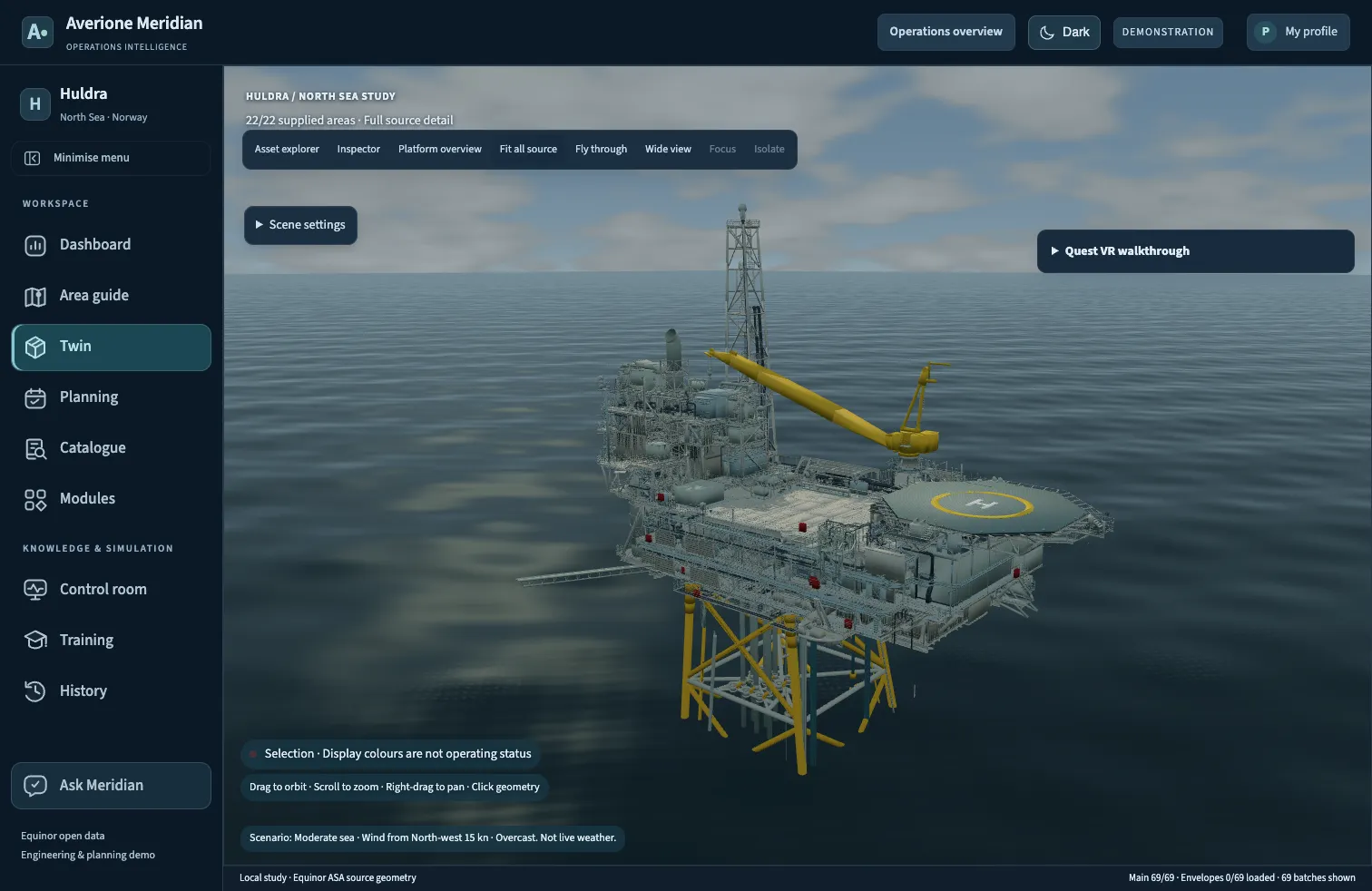
Offshore platform
Huldra connects source inspection with work preparation, planning and training.
Onshore process plant
Explore equipment and source records, observations and familiarisation.
Turbine / generator
The OPEN100 example covers the turbine/generator assembly, not a complete power station.
Equipment
Identify the asset and its source information
Work pack
Capture tasks, hazards and proposed controls
Coordination
Check work windows and nearby activity
Briefing
Prepare the JSA and toolbox-talk drafts
Review
Record the reviewer and the information reviewed
Scope, dates or overlapping work changed? Revisit the review.
Preparation and review support. Work authorisation remains with the responsible organisation.
Work preparation / JSA
Turn the job into a clear work pack.
Link the pack to equipment, a job, an area and a work window. Set out the scope, conditions, unresolved questions and reasons to stop or reassess before work begins.
- 01
Define the work
Set out ordered task steps and evidence references. Record what is known, what still needs checking and when the work must be reassessed.
- 02
Assess the task
Capture hazards, affected people, proposed controls and control owners. Record initial and residual rankings with the assessor’s rationale; unknowns remain unassessed.
- 03
Prepare the briefing
Export a job safety analysis (JSA) draft and toolbox-talk draft from the recorded pack. Outstanding information travels with the draft.
- 04
Keep reviews current
Each review records who reviewed it, when, and the information they saw. A change to the pack, linked job or overlapping work marks that review as out of date.
Structured preparation and review support: the current demonstration risk matrix is illustrative. Site-approved assessment criteria, competent review and operational authorisation remain with the responsible organisation. Recording a control does not automatically reduce a risk score.
SIMOPS & shutdowns
See where work meets work.
Simultaneous operations need a shared view of location, timing and responsibility. Meridian flags jobs that overlap in the same area and time, and retains the coordination discussion beside them.
Coordinate the work fronts
Review nearby work, dependencies and permit references. Revisit the coordination record when dates, location, scope or overlap inputs change.
Prepare the turnaround
Bring shutdown scope, access, crews, material requirements, isolation references and restart-readiness records into the planning review.
Overlap screening is based on area and time. It does not infer process connectivity, issue permits, establish isolations or authorise a restart.
Work / time / cost / materials
Plan the work around time, cost and materials.
Maintenance & work orders
Priorities, responsibilities, predecessor jobs, status and completion notes keep the work visible from preparation to close-out.
Schedule & cost
Identify schedule conflicts and dependencies. Compare estimates with budgets and recorded actual costs, keeping incomplete cost records visible.
Parts & readiness
Review stock, reservations and shortages alongside suppliers, lead times, orders and expected deliveries. Connect material needs to the work they support.
Need sourcing or physical delivery? Explore Averione’s separate supply-chain service →
Familiarisation & training
Practise the decisions. Discuss the consequences.
A structured learning catalogue
42 draft course packs and six interactive management exercises support familiarisation, facilitated discussion and debriefs. Topics span control of work, emergency management and response, environment, induction and human factors, marine and aviation, process and wells, and technical maintenance.
Student material, instructor notes and distinct cases give facilitators a starting point for a programme adapted to the site and role.
Control-room practice
Illustrative wells, separation, compression and utilities exercises let participants explore alarms, trends and operator actions, then use the action record in a debrief.
Desktop learning is the current demonstration route. Native headset development is in progress; physical headset acceptance remains pending.
Draft learning material is not accredited training. Control-room exercises use illustrative assumptions, not live telemetry or validated engineering and incident physics. Site procedures and learning outcomes require review for the intended use.
Connected module coverage
Sixteen modules connected to the work.
Keep equipment, work orders, owners, notes and references connected across sixteen registers and checklists. Explore the coverage below. Specialist calculations and formal approvals remain with the responsible systems and people.
01 · Emergency response
Record exercise objectives, roles, scenario assumptions and debrief actions.
02 · Immersive training
Organise familiarisation, role practice and learning evidence; headset delivery is subject to physical acceptance.
03 · Engineering & modifications
Link proposed changes to equipment, source references and review actions.
04 · Projects, cost & schedule
Bring work dependencies, estimates, recorded actual costs and budgets into the planning discussion.
05 · Shutdown planning
Coordinate work fronts, access, crews, materials, isolation references and restart-readiness records.
06 · Maintenance & reliability
Track work orders, priorities, responsibilities, dependencies, status and completion notes.
07 · SIMOPS & permits
Record same-area/time overlaps, coordination reviews and permit references.
08 · Inspection & integrity
Link inspection observations, evidence and follow-up to the relevant equipment.
09 · Operations & awareness
Capture operating context and observations alongside the facility model.
10 · Parts & logistics
Connect stock, reservations, shortages, suppliers, lead times, orders and expected deliveries.
11 · Marine operations
Record marine interfaces, supporting references and coordination actions around the facility.
12 · Equipment access & removal
Prepare removal sequences, access and handling references, and recorded clearance evidence.
13 · Commissioning & restart
Track test references, punch items, handover evidence and readiness review.
14 · Procedures & knowledge
Keep procedure references, revisions and experienced-worker guidance in context.
15 · Management of change
Record the reason for change, affected equipment and people, reviewers and restoration approach.
16 · Decommissioning
Prepare removal scope, dismantling sequence, survey gaps and disposal or reuse records.
A practical starting point
Start with a practical use for your facility.
Available to demonstrate
Source inspection, Huldra work packs, planning, connected registers and learning exercises. A read-only contextual AI assistant can explain available information without changing records or approving work.
Adapted to your facility
Agree the model and document sources, equipment identity, users and responsibilities. Review data coverage, site criteria and acceptance measures before relying on a workflow operationally. Feature coverage varies by environment.
Further development
Evidence-linked AI drafting, circuit mapping, incident modelling, verified routes and muster, temporary arrangements, and drone or spill interfaces are roadmap work, subject to evidence and validation.
Start with one facility and one useful workflow.
Tell us what you need to achieve. We will help define the scope and the next useful step.