Integrated command
Eleven screens, zero visibility
Good sensors are not enough when operators have to piece the evidence together themselves.
David Voigts3 min read
Walk into most control rooms and you will count the screens. Radar on one. Fenceline on another. Cameras on a third. Access control on a fourth. A counter-drone display someone bought after the last scare. Each may do its own job well. And together they produce something none of them intended: blindness.
Excellent components, absent picture
The security industry has a structural bias. Manufacturers optimise their layer and stop at their hand-off point, because that is where their responsibility and their expertise end. Nobody is paid to own the space between the layers. So the integration burden, the hardest and most valuable part of the whole system, lands on the operator, who is the party least equipped to carry it.
The result is a familiar control-room problem: eleven screens, eleven alarm philosophies, eleven truths, and one operator who cannot possibly watch all of them. When the fence alarms, the radar track that would have explained it is on a different screen, in a different colour language, with a different clock. The information needed to make the decision exists. It is just scattered across eleven panes that were never designed to be read together.
Visibility is not coverage
Here is the trap that catches good teams. They measure coverage: how many cameras, how many sensors, how much of the perimeter is instrumented. And they assume it equals visibility. It does not. You can instrument a hundred per cent of an asset and see almost none of it, if the instruments don’t converge. I have watched operations move from a fraction of real visibility toward full coverage without buying a single new sensor, just by fusing the ones they already had into one picture.
Coverage is what you bought. Visibility is what you can actually act on. The gap between them is where incidents live.
What one source of truth actually requires
“One source of truth” is easy to say and hard to build. Technically it requires three things most estates lack.
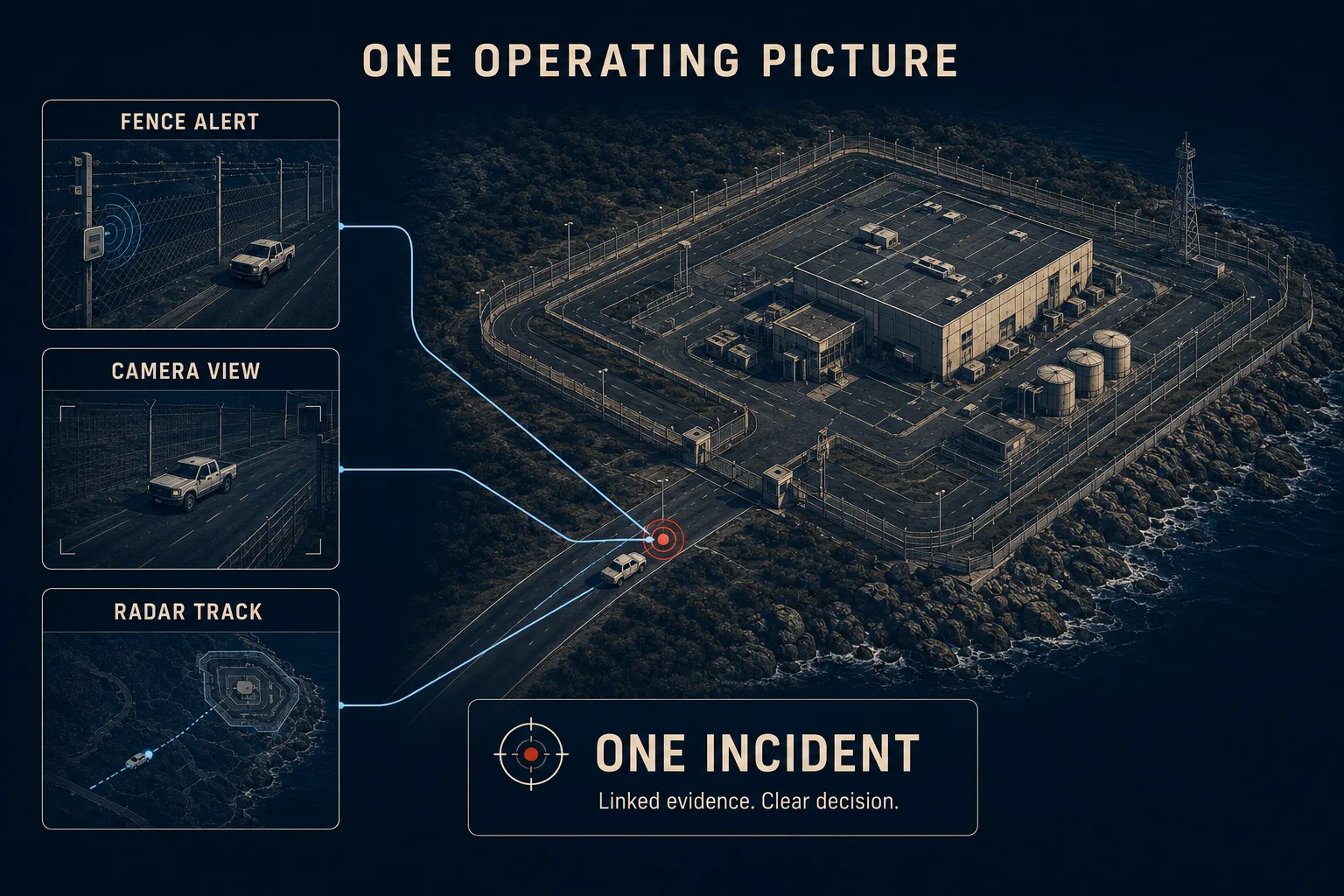
First, a common picture: every sensor’s output rendered in one operating picture, in one visual language, on one clock, so a fence event and a radar track are the same story told once.
Second, correlation: the system, not the operator, notices that the access denial, the perimeter event and the loitering contact are related, and presents them as one incident rather than three alarms.
Third, a workflow: a designed path from alarm to decision, so the room is watching for something rather than staring at everything. An operator cannot give every screen the same attention at the same time.
The economics of the seam
The value of integration starts with the equipment you already own. The work is to establish what can be connected, what evidence can be correlated and how operators will use it. Some systems may need changes or replacement; the assessment should make those limits clear.
Start by asking whether your operators can follow one incident across the systems you already own.