Security economics
One post, five salaries
A continuously staffed post needs cover beyond its nominal hours. Cost the role in full before deciding what technology should change.
David Voigts3 min read
One post is a coverage requirement.
168
hours to cover each week
40
hours in an illustrative working week
168 ÷ 40 = 4.2 people before relief
Leave, sickness, training and breaks increase the staffing requirement. Supervision and other overheads increase the cost.
The question we hear from security leaders is some version of this: how do I take cost out of the ground force without taking on risk?
Start with the job the post does and the hours it needs to cover. Otherwise the comparison begins with a wage and ends with a promise.
Start with the staffing requirement
A post staffed around the clock needs 168 hours of coverage a week. If a full-time officer works about 40 hours, that is already more than four people before annual leave, sickness, training and breaks are covered. Roughly five salaries is a useful prompt for the calculation, not a universal staffing rule.
Use the actual roster and employment arrangements. Add supervision, insurance, uniforms, equipment, transport, licensing and any agency costs that apply. Recruitment and replacement costs belong in the comparison too. The staffing cost recurs each year.
Separate the tasks
A patrol observes, but it may also investigate, assist staff, control access and respond. A gatehouse can be both an observation point and a place where a person resolves an exception. List those functions before deciding which could change.
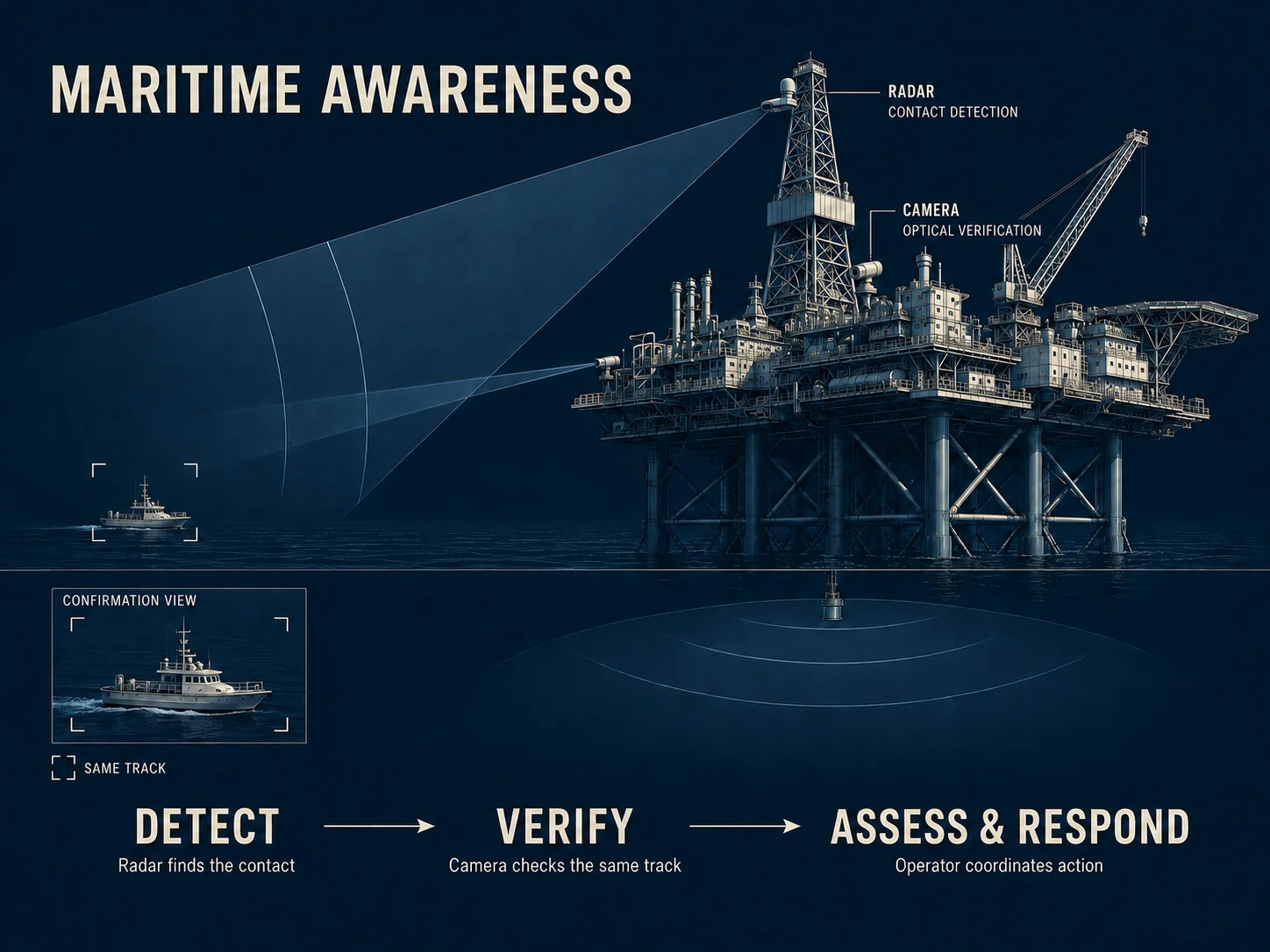
Continuous sensing changes how much of the perimeter can be monitored at once. Cameras and access records can give operators additional evidence. They still need power, communications, maintenance and people who can assess an alarm and act on it.
Compare complete operating costs
Include equipment, installation, licences, operator workload, maintenance and replacement in the technology option. Retain the cost of the response team and any duties that still require a person on site. A comparison that omits those costs has not established a saving.
Guarding companies such as Securitas and GardaWorld also offer technology alongside people. Their examples can inform the questions you ask, but a result from another client is not a saving your site has already earned.
What stays human
Technology cannot detain, de-escalate, exercise judgement in an ambiguous situation or represent your organisation at a front desk. Those responsibilities need capable people and clear procedures.
The useful question is where routine observation can be supported by technology so that the team has more time for assessment and response. It is not a reason to remove people before their duties have been understood.
Where to start
Cost each post at its fully loaded rate and list its functions. Select one observation task for a pilot. Set a site-specific cost target and test it alongside detection, response, availability and operator workload.
Record the assumptions and compare the measured result with the existing arrangement. If the ground force is a major security cost and nobody can say precisely what each post contributes, that is the conversation to have.